Pages

Tampilkan postingan dengan label california. Tampilkan semua postingan

Jumat, 26 Februari 2016

US impressions Recycling updates in California


Well, its 5am Californian time and Ive realised that the only chance of keeping this blog up-to-date is to wake up this early.  I guess its not too much of a hardship though because the whole jetlag thing that Im experiencing for the first time is making sure I bob in and out of sleep at the end of the working day until the early hours of the morning.  Im sure Ill get used to it by the end of the week, in time for the Friday night party!

But even yesterdays conference the NCRA Recycling Update  felt much like a party.  It was certainly much more relaxed than any conference that Ive attended before. Still as professional, with representatives from federal and state departments, waste management companies, independent consultants etc, yet it felt like it was a large group of old friends getting together for a catch up.  As it turned out, many of the the people in the room were old friends, who have strived together over the last 20 years.  I loved the atmosphere of in-jokes and celebratory applauses during the event yesterday as well as the fact that attendees were encouraged to bring their own reusable coffee cups.

But what did I learn? 

Perhaps the fact that shouted most loudly yesterday was that San Francisco, with just 20% of its waste going to landfill is most definitely a shining light in the US recycling sector, with the rest of the US landfill rates currently at 54%.  And as for the value of wasted packaging materials in the US, that currently stands at a whopping $11,402,020,357.

 (Source: As you Sow)

Elsewhere, according to food waste awareness project Food Shift, $165 billion worth of wasted food is thrown out each year, with the US spending $750 million on its disposal.

These are huge problems and naturally very similar to those that we have to tackle in the UK.  And just like us, there is much strategising to resolve the issues at all levels of the waste hierarchy, with particular pushes to introduce single use bag bans/taxes, development of Anaerobic Digestion plants, managing construction & demolition waste, pushing for extended producer responsibility, standardising packaging labelling, developing reuse opportunities and pushing food waste further up the hierarchy.

So for anyone sat in the UK, pondering the impact of their own actions and thinking whats the point of me doing something, when we look at how much America wastes, from what Ive seen so far my message is its time to wake up and smell the coffee because this huge continent is busying itself with solutions and action plans to sort it out.  It is also leading the way with zero waste ambitions while adopting good practice thats emerging from other countries too.

It would take me all week to feature all of the great things that came out of yesterdays conference, so being in no position to do that, Im going to leave you with just a few of the highlights and links for you to ponder.

1.  Even when food waste collections are brought into place, examples from Portland and San Francisco show that home composting is still very much encouraged and adopted.  Stats from Portland reveal that 50% of Portlanders still home compost.

2. Across the States, there is still much work to do in improving the recycling infrastructure, as many residents still dont have access to easy recycling facilities.

3. Reuse is a growth industry.  Oregons St Vincent de Paul provides a great example of how a thrift store, which once contributed much of its donations to landfill, now has a diversion rate of 95%.  The charitys Terry McDonald gave examples that despite competition from sites such as Amazon, its book retail charity brings sales of $1.2b per year.  In recent years, it has also found opportunities in the mattress sector, both in rebuilding mattresses for reuse and reselling components for recycling.  It imports dark oak furniture from Europe, which has a better resale value here, whereas in places such as the UK and Belgium such furniture could have been scrapped for wood recycling/landfill/recovery.  Other examples of innovative processing include creating tumbled glass for reselling to the floristry and creative industries, remelting candle wax to create fire-bricks and collecting single shoes to help amputees.

4. A great scheme that is piloting the reuse of what are normally defined as Hazardous Waste Products, is Tehama Countys REAP project (Reuse of Available Products), which redistributes cleaning products, stains, paints, polishes, automotive fluids and more to the public free of charge.  More information can be found about it here.

5. There is still much to do with overcoming confusing packaging labelling, especially as the US has similar problems to the UK where the recycling facilities vary across counties and states.  However, the Sustainable Packaging Coalition is trying to consolidate and standardise messages to help consumers. The website www.how2recycle.info shows how new labelling has been developed, following the lead of the UKs own On Pack Recycling Label (OPRL).  There is also a list of organisations that are now adopting it.

6. Food Shifts Dana Frasz is a leading light in the area of food waste, campaigning to push food waste management further up the hiearchy, so that it is distributed to the hungry way before it ever becomes treated as a waste material and using it as an opportunity for job creation.  More details can be found at www.foodshift.net.

7. Eric Lombardi of Eco-cycle and Dr Jeff Morris of Sound Resource Management Group presented one of their latest analytical models comparing MBT (which theyve redefined as MRTB - Mechanical Recovery Biological Treatment) Landfill and Energy from Waste solutions, in relation to treating differing percentages of residual/solid waste.  Their tools model data against Climate Change impacts, Acidification, Respitory Diseases, Ecotoxity and much more. Further information about this kind of work can be found at www.zerowaste.com/pages/MEBCalc.htm.

I feel guilty about leaving so much out, but as soon as links to the presentations are available, I will include them here.  Meanwhile, heres a link to the movers and shakers who featured in yesterdays jam-packed programme.

So with yesterdays California/US focus, todays conference moves towards the international scene, hosted by the Zero Waste International Alliance, where we look forward to hearing some of the challenges, opportunities and fantastic initiatives from around the rest of the world.

Please excuse me, while I head for breakfast, grab some much-needed coffee and get cracking on another busy day.  I promise, I will be back to respond to the emails, comments and tweets later.

Read More..

Kamis, 18 Februari 2016

Zero Waste greetings from California


So here I am, thousands of miles away from home, following in the footsteps of Jeremy Irons and his recent movie Trashed.  Except, Ive not ended up in Hollywood.  Im somewhere far more exciting! Yep, as part of this years international Zero Waste conference, Im on location in San Francisco, visiting Recycle Central, which was featured in the documentary, and exploring how the city and county of San Francisco is so advanced in its journey towards Zero Waste.

And that trash truck that you see there, is one of the few that can be seen heading for landfill, taking less than 5% of waste from Recologys recycling MuRF/Recycling Depot, after the paper, plastic, cardboard and cans have been baled for processing.   Overall, thanks to its well-streamed organics and recycling facilities, San Franciscos diversion rate from landfill is 80%, not only placing it high on the Zero Waste league table, but well on its way to its goal of 100% Zero Waste by 2020.

And thats Zero Waste to landfill or incineration!

Now thats a very high ambition indeed and gives many of the best Zero Waste goals of even the UK a run for their money,  but judging by what Ive seen on my first day, I would bet my bottom dollar (see how I threw in that local colloquialism there) that San Francisco is going to achieve it, or at least get pretty damn close.

And this stems from the fundamental belief that the rubbish generated by San Franciscos visitors, businesses and residents is too valuable to bury or burn and has much higher economic, social and environmental value being reused or recycled as a resource.   Consequently, San Franciscos municipal Environment Department and business community have overcome many of the perceived barriers and hurdles, working together to introduce alternative solutions that benefit their zero waste agenda and its local community.

As we drove away from Recycle Central yesterday, these solutions were pretty easy to spot, with the piles of demolition rubble that now has to be processed for construction reuse instead of being buried in landfill.  Further afield, but close to the city, organics (including all forms of food waste) are also diverted out of the landfill thanks to composting and AD facilities, creating a product that is now highly in demand by local vineyards, farms and recreation facilities.

But to achieve this, high levels of participation are needed and during our tour around the very popular Fishermans Wharf, it became clear how re-education, attitudes and the right financial leverage tools are helping to realise San Franciscos Zero Waste culture, especially within the business sector.

Take Scomas Fish Restaurant for instance.  According to one of its executive chefs Kelly, who gave us a behind-the-scenes tour, it now diverts 97% of its waste from landfill, saving an estimated $1100 per month. 


Scomas is one the top 20 grossing restaurants in the United States, with 170 staff on its books, serving up to 2000 people a day.  Its corporate philosophy is heavily linked to sustainability and embraced by its staff and thanks to the supporting waste collection infrastructure, diverting restaurant waste from landfill has become very easy.

As Kelly says "its not hard, its just using a different coloured garbage can".

But businesses in Fishermans Wharf dont just stop at recycling goals.  There are some great examples of waste prevention too, and one of these is the lead being shown by fish supplier Two X Sea, which has redesigned their distribution packaging from disposable cardboard boxes to reusable hotel pans.


Owner Kenny Belov took us through how his companys one off investment of $8,000 in the streamlined reusable system, which integrates with the storage facilities of his customers, not only saves his company huge amounts of money from being wasted through disposable packaging, but it also saves his customers time and cash too as they dont need to process or repackage the fish at the other end.

While all this is happening behind-the-scenes in Fishermans Wharf, there is also more visible change on the streets too.

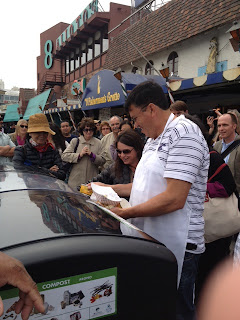
Our guide for the day, Lisa Lukacs, a Zero Waste consultant whos working closely with the wharf, demonstrated how the port authorities are changing their management of recycling through the application of the Big Belly solar recycling bins on Pier 45.


With facilities for passers-by to fully separate compostables and recycling, the system also has a solar-powered compacting system to manage the residual trash, alerting the authorities electronically when its ready to be emptied.  With a leasing agreement of $230 per month, this method has already demonstrated a reduction in labour costs associated with emptying regular bins.

The days tour ended with a presentation from San Franciscos municipal environment department, which addressed a whole range of topics from the 10c single use bag charge, the significance of the food hierarchy in diverting usable food to the San Francisco food banks and the promotion of home composting.  Also covered were the success of the Green Apartment programme as well as links to schools.


As the county progresses further down the path towards zero waste, there will now be a focus on extended producer responsibility, including redesigning waste out of the system and greater financial contributions for disposal.

You can find more about departments Zero Waste programme here at www.sfenvironment.org.

Of course, a day of introductions to San Franciscos Zero Waste initiatives wouldnt have been complete without a screening of Trashed at the Aquarium of the Bay, which is itself closely connected to the ZW goals.  The avid applause and whoop-whoops from the audience at seeing the achievements of San Francisco featured in the documentary were entirely appropriate, enjoyable and very well deserved.

It was inspiring enough to have seen these examples from afar as an audience member in the UK, but to have witnessed them in person has been even more of an eye-opener to the opportunities that are available to work towards zero waste efficiently and effectively.

There are great lessons to be learned from San Francisco and over the next few days week, I hope to find out more as well as discover news of whats happening from across the world at the zero waste conference that is bringing together experts from countries that include the US, Sweden, Italy, Wales, Brazil, Columbia, India, Bhutan, the Philippines, Italy, Canada and Australia.

It will be a real privilege to find out about some of the best practice from across the world and also share my experience of The Rubbish Diet with them too.  My thanks go to the Zero Waste Alliance UK and Zero Waste International Alliance for providing me with this fantastic opportunity.

More news will be shared soon.

____________________________________

Read More..